Could Artemisinin Help My Dog with Cancer?
Jun 16, 2026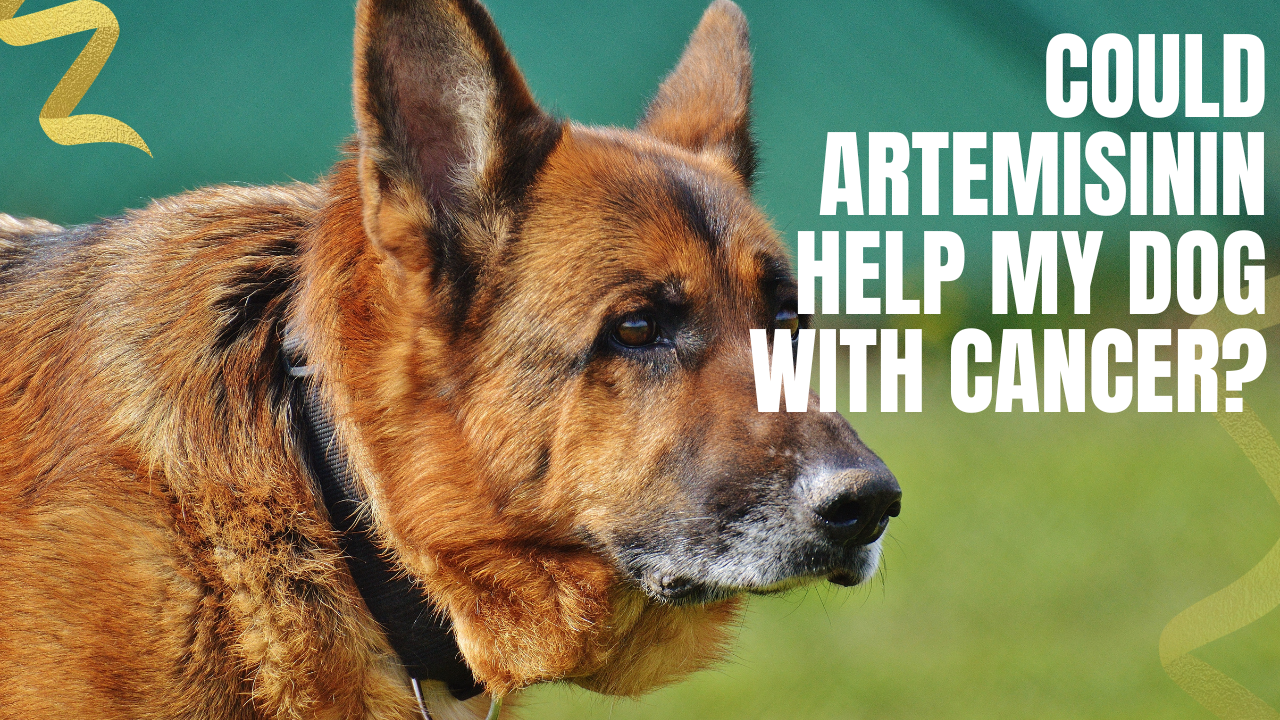
Artemisinin, a plant-derived antimalarial drug, is being studied as a possible cancer treatment for dogs, and the honest answer to whether it works is that it shows early promise but remains unproven. Preliminary canine research suggests it may help stabilize some tumors that have stopped responding to other treatments, but those findings come from small, mostly uncontrolled studies, and the most striking results actually used semi-synthetic derivatives rather than artemisinin itself. Its poor absorption in dogs is a major reason most veterinarians have not adopted it, so for now it is best treated as an investigational option to raise with your veterinarian, never as a substitute for treatment with proven benefit.
Artemisinin is extracted from the plant Artemisia annua, known as sweet wormwood and, in traditional Chinese medicine, as qinghao. People have used the plant to bring down fevers for roughly two thousand years, and in the modern era artemisinin became one of the most important antimalarial drugs available, a contribution that earned Chinese scientist Youyou Tu a share of the 2015 Nobel Prize in Physiology or Medicine.
Over the past two decades, laboratory and early clinical work has raised a genuinely interesting question: might a drug this effective against malaria parasites also have a role in cancer care, including for dogs? A handful of veterinarians have started to explore it, and this article walks through what the evidence does and does not support, including why cautious optimism runs into one stubborn practical problem, which is getting enough of the compound into a dog's bloodstream in the first place.
First, a word about terminology
One of the most common sources of confusion in this area is the difference between artemisinin the natural compound and its laboratory-modified relatives. Chemists have created a family of semi-synthetic derivatives, including artesunate, dihydroartemisinin (often shortened to DHA), and artemether. These were designed to be more water-soluble, better absorbed, and in some cases more potent than the parent compound.
This matters because most of the anticancer research, and nearly all of the most eye-catching clinical results, actually involve derivatives rather than artemisinin itself. The parent compound and its derivatives behave quite differently once inside the body, so lumping them together under a single label can be misleading. Throughout this article, when the underlying study used a specific derivative, that is noted directly.
How artemisinin is thought to work against cancer
The leading explanation centers on a distinctive chemical feature of the molecule called an endoperoxide bridge. When this bridge encounters iron, particularly the reactive ferrous form and iron bound within heme, it breaks apart and generates highly reactive free radicals and reactive oxygen species. These molecules damage nearby cell components, injure DNA, and can push a cell toward programmed death, a process known as apoptosis. Some studies also point to effects on new blood vessel growth and on the spread of tumor cells (Efferth, 2017).
The appeal for cancer treatment comes from a proposed selectivity. Many cancer cells overexpress transferrin receptors and take up more iron than normal cells do to fuel their rapid division. In theory, that iron-rich internal environment is exactly what activates artemisinin, so the compound may concentrate its damage on abnormal tissue while leaving most healthy cells relatively untouched.
Researchers have even examined transferrin receptor expression in pet tumors as a possible marker of how well a tumor might respond (Saeed et al., 2020). It is worth stressing that this remains a proposed mechanism supported by laboratory work, not a fully settled account of what happens in a living patient.
What the canine evidence shows
The dog-specific research is real but limited, and reading it carefully is essential.
The most substantial clinical study is a safety and efficacy field trial in 23 dogs with non-resectable tumors that had proven or expected resistance to conventional chemotherapy (Rutteman et al., 2013). These dogs received oral artesunate at a median dose of 922 mg per square meter for anywhere from 7 to 385 days. One dog achieved a long-lasting complete remission, and another seven experienced short-term stabilization of disease, so roughly a third of the group saw some measurable benefit. Encouragingly, no neurological or cardiac toxicity was observed. The most frequent problems were transient fever and reversible blood and gastrointestinal effects.
A second study is arguably the most sobering. Researchers gave 24 dogs with spontaneous tumors either a low continuous dose or a high intermittent dose of oral artemisinin and measured what actually reached the bloodstream (Hosoya et al., 2014).
Both regimens were well tolerated, but blood concentrations of artemisinin and its active metabolite stayed below the level needed for meaningful analysis, even in the high-dose group. The authors concluded that dogs absorb the compound poorly through the gastrointestinal tract. More on why this matters below.
A retrospective analysis offers a more hopeful signal, with important caveats. Investigators compared small pets receiving standard therapy plus a commercial Artemisia annua preparation and supplemental iron against a control group receiving standard therapy alone (Saeed et al., 2020). Significantly more animals in the treated group survived beyond 18 months. This was a small, retrospective, mixed population of dogs and cats, and it used a whole-herb preparation combined with iron rather than isolated artemisinin, so it should be read as a lead worth following rather than proof of benefit.
Earlier work in the same vein reported on three dogs and one cat with sarcoma treated with surgery followed by adjuvant A. annua, several of which had unusually long relapse-free survival (Breuer & Efferth, 2014). And in the laboratory, dihydroartemisinin has shown activity against canine osteosarcoma cell lines, which helps explain the interest in that particularly aggressive bone cancer (Hosoya et al., 2008).
Across these studies, the canine cancers investigated have included histiocytic sarcoma, osteosarcoma, hemangiosarcoma, oral melanoma, squamous cell carcinoma, and lymphoma.
The single most-cited human result
Discussions of artemisinin and cancer almost always mention one case report. A 72-year-old man with laryngeal squamous cell carcinoma was treated with artesunate, first by injection and then orally, and his tumor shrank by roughly 70 percent within about two months, with a meaningful improvement in his quality of life (Singh & Verma, 2002).
That is a striking outcome, and it deserves an equally clear qualifier. It is a single case report, published more than two decades ago, using a derivative rather than the parent compound. Other isolated human reports and small trials in melanoma, cervical cancer, and colorectal cancer have produced mixed results. Taken together, the human literature offers a signal, not a verdict.
Why more veterinarians are not using it: bioavailability
This is the crux of the matter. Artemisinin itself is poorly absorbed when given by mouth. It has low water solubility, a short half-life, and is heavily metabolized on its first pass through the liver, which is exactly what the canine blood-level study demonstrated (Hosoya et al., 2014). When a drug barely reaches the bloodstream, the intuitive fix is to raise the dose, but that runs into real limits. Very large doses are hard to give to a dog who resists pilling or objects to eating large amounts of herb, and pushing the dose also raises the risk of side effects such as anemia.
This is a major reason the derivatives look better in studies. Artesunate, for instance, is far more water-soluble than the parent compound and is absorbed more reliably, which helps explain why artesunate trials have produced clearer responses than pure oral artemisinin.
There is one intriguing wrinkle worth mentioning honestly. In rodent malaria models, feeding whole dried A. annua leaf produced dramatically higher artemisinin blood levels than an equivalent dose of the purified drug, in some experiments around 40 times higher (Elfawal et al., 2012; Weathers et al., 2014). The plant's other natural compounds appear to improve solubility and slow the drug's breakdown. That is a fascinating finding, but it comes from mice and from malaria, not from dogs and not from cancer, so it cannot yet be assumed to apply to canine oncology.
Safety and side effects
When given orally, artemisinin and its derivatives are generally well tolerated in dogs. The side effects reported most often are:
- Decreased appetite
- Vomiting
- Fever
- Anemia
The alarming neurological and cardiac toxicities seen in some early animal experiments came from high doses of injectable derivatives, not from typical oral use, and the largest canine oral study saw none of them (Rutteman et al., 2013). Anemia deserves particular attention, both because it ties directly into the iron-based mechanism and because cancer itself can lower red blood cell counts, so periodic bloodwork is sensible during treatment. In people, some users of artemisinin derivatives have reported dizziness or vertigo that resolved after stopping the supplement.
Interactions with other medications and supplements are largely uncharacterized, and side effects appear more likely when artemisinin is combined with other treatments. That makes a conversation with your veterinarian about everything your dog is currently taking an essential first step, not an optional one.
Using it alongside other treatments
Much of the current interest lies in combination, not replacement. Artemisinin and its derivatives are being investigated alongside chemotherapy and radiation, where laboratory work suggests they may sensitize tumors to those treatments or add to their effect. Some researchers have also paired the compound with iron in an effort to feed the very mechanism described above. All of this is genuinely investigational, the supporting data in dogs are thin, and iron supplementation is not risk-free, so none of it should be attempted without veterinary guidance.
The bottom line
Artemisinin is a biologically plausible and legitimately interesting candidate in canine cancer care. It has a coherent tumor-selective rationale, early signals of activity across several tumor types, and a reassuring safety profile when given by mouth. Those are real strengths.
The honest counterweights are equally important. The most impressive results in both dogs and humans used derivatives such as artesunate rather than artemisinin itself. The canine efficacy evidence is small, mostly uncontrolled, and largely a decade or more old. And the parent compound is absorbed so poorly by dogs that its practical usefulness in its purest oral form is genuinely uncertain.
For a dog with a cancer that has few good conventional options, artemisinin is reasonable to raise with a veterinary oncologist or an integrative veterinarian who can weigh it against the specific tumor type and the rest of the treatment plan. What it is not is a proven therapy or a do-it-yourself project.
References
Breuer, E., & Efferth, T. (2014). Treatment of iron-loaded veterinary sarcoma by Artemisia annua. Natural Products and Bioprospecting, 4(2), 113–118. https://doi.org/10.1007/s13659-014-0013-7
Efferth, T. (2017). From ancient herb to modern drug: Artemisia annua and artemisinin for cancer therapy. Seminars in Cancer Biology, 46, 65–83. https://doi.org/10.1016/j.semcancer.2017.02.009
Elfawal, M. A., Towler, M. J., Reich, N. G., Golenbock, D., Weathers, P. J., & Rich, S. M. (2012). Dried whole plant Artemisia annua as an antimalarial therapy. PLOS ONE, 7(12), e52746. https://doi.org/10.1371/journal.pone.0052746
Hosoya, K., Couto, C. G., London, C. A., Kisseberth, W. C., Phelps, M. A., & Dalton, J. T. (2014). Comparison of high-dose intermittent and low-dose continuous oral artemisinin in dogs with naturally occurring tumors. Journal of the American Animal Hospital Association, 50(6), 390–395. https://doi.org/10.5326/JAAHA-MS-6145
Hosoya, K., Murahari, S., Laio, A., London, C. A., Couto, C. G., & Kisseberth, W. C. (2008). Biological activity of dihydroartemisinin in canine osteosarcoma cell lines. American Journal of Veterinary Research, 69(4), 519–526. https://doi.org/10.2460/ajvr.69.4.519
Rutteman, G. R., Erich, S. A., Mol, J. A., Spee, B., Grinwis, G. C. M., Fleckenstein, L., London, C. A., & Efferth, T. (2013). Safety and efficacy field study of artesunate for dogs with non-resectable tumours. Anticancer Research, 33(5), 1819–1827.
Saeed, M. E. M., Breuer, E., Hegazy, M.-E. F., & Efferth, T. (2020). Retrospective study of small pet tumors treated with Artemisia annua and iron. International Journal of Oncology, 56(1), 123–138. https://doi.org/10.3892/ijo.2019.4921
Singh, N. P., & Verma, K. B. (2002). Case report of a laryngeal squamous cell carcinoma treated with artesunate. Archive of Oncology, 10(4), 279–280. https://doi.org/10.2298/AOO0204279S
Weathers, P. J., Elfawal, M. A., Towler, M. J., Acquaah-Mensah, G. K., & Rich, S. M. (2014). Pharmacokinetics of artemisinin delivered by oral consumption of Artemisia annua dried leaves in healthy vs. Plasmodium chabaudi-infected mice. Journal of Ethnopharmacology, 153(3), 732–736. https://doi.org/10.1016/j.jep.2014.03.028
Reviewed by: Amber L. Drake, PhD
Dr. Amber L. Drake is a board-certified holistic health practitioner, canine clinical herbalist, educator, and founder of the Drake Dog Cancer Foundation and Drake Dog Academy. She is dedicated to helping pet parents better understand canine cancer, treatment options, nutrition, quality of life, and supportive care through compassionate, evidence-informed education. Her work combines professional training, practical resources, and firsthand insight from supporting thousands of dog families through the challenges of a cancer diagnosis.
Stay connected with news and updates!
Join our mailing list to receive the latest news and updates from our team.
Don't worry, your information will not be shared.
We hate SPAM. We will never sell your information, for any reason.