Apocaps for Dogs: What the Evidence Says About Apoptosis
Oct 30, 2026
Apocaps is a supplement made by Functional Nutriments and marketed to support apoptosis, the process cells use to shut themselves down when they're old or damaged (Functional Nutriments, n.d.-a). The idea behind it is reasonable. Cancer cells are known for dodging that shutdown, and several of the plant compounds associated with Apocaps can push canine cancer cells into apoptosis in laboratory dishes (Ryu et al., 2019).
What's missing is proof that the capsule does this inside a dog. We couldn't find a single published, peer-reviewed study testing Apocaps in dogs with cancer. The research on its ingredients comes almost entirely from cells grown in a lab, and at least one ingredient, curcumin, only slowed canine cancer cells at concentrations higher than dogs actually reach in their tissues (Withers et al., 2018). Apocaps may still help some dogs feel better, but "supports apoptosis" is a hypothesis, not a demonstrated effect. If you're considering it, talk with your oncology team first, especially if your dog is having chemotherapy, radiation, or surgery.
Key Points
- Apocaps is sold as a "palliative supplement" that supports apoptosis, not as a cancer treatment (Functional Nutriments, n.d.-a).
- Each capsule contains a proprietary blend of roughly 393 to 399 mg, depending on the label version, with no amounts given for individual ingredients (Functional Nutriments, 2018; VetRxDirect, n.d.). An older label lists luteolin and apigenin by name, while the current US listing names a citrus bioflavonoid complex instead (Functional Nutriments, 2018; VetRxDirect, n.d.).
- Luteolin triggered apoptosis in canine osteosarcoma cells in a lab study (Ryu et al., 2019). Lab results like this often don't carry over to living animals.
- In a canine study of an injectable curcumin, the compound only slowed cancer cell growth at concentrations above what reached dogs' lung tissue, and no tumors shrank in treated dogs (Withers et al., 2018).
- No peer-reviewed clinical trial of Apocaps in dogs appears in the published literature that we could find. The company says it received an NIH grant in 2010 but gave it up when it chose to stay a supplement company (Functional Nutriments, n.d.-b).
- The product's own insert says some ingredients may enhance chemotherapy and radiation, and advises caution with bleeding disorders, NSAIDs, steroids, and surgery (Apocaps UK, 2018).
Detailed Explanation
What apoptosis is, and why cancer matters here
Healthy bodies constantly replace their own cells. Old or damaged cells get a signal to dismantle themselves neatly, a built-in process called apoptosis, sometimes described as programmed cell death. It's how the body clears out cells that shouldn't be there anymore.
Cancer cells are, in part, cells that have learned to ignore that signal. They keep dividing when they should have shut down. That's why apoptosis is a real target in cancer research, and several approved cancer drugs work, at least partly, by tipping cancer cells back into it. Newer approaches such as immunotherapy work in other ways. Our article on what chemotherapy is explains how conventional treatment attacks cancer cells.
So the question isn't whether apoptosis matters. It does. The question is whether swallowing a particular supplement can trigger it in a tumor, in a safe amount, inside a living dog. That's a much harder thing to prove.
What's in Apocaps
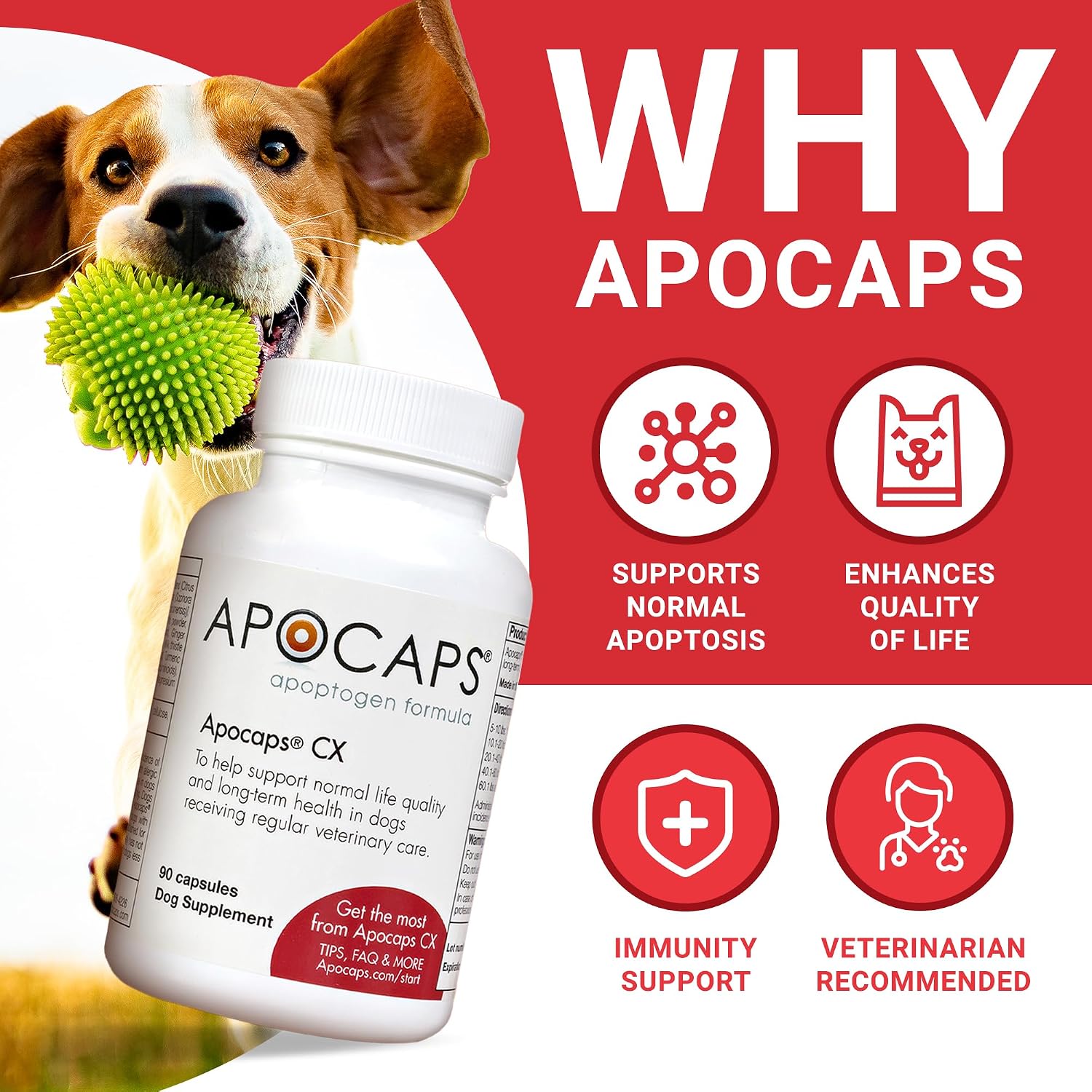
Apocaps was designed by veterinarian Dr. Demian Dressler, who owns a veterinary hospital on Maui and co-founded Functional Nutriments with CEO James Jacobson (Functional Nutriments, n.d.-b). The full name is Apocaps CX. The current product page lists these ingredients: Japanese pagoda tree (Styphnolobium japonicum) extract, orange and grapefruit extracts, ascorbyl palmitate (a form of vitamin C), lecithin, L-glutamine, taurine, zinc oxide, ginger root extract, milk thistle seed extract, turmeric root extract, beta-glucans, and magnesium oxide, plus capsule ingredients (Functional Nutriments, n.d.-a). The page also mentions a proprietary "Biovadex" delivery technology without describing what it is (Functional Nutriments, n.d.-a).
The label has changed over time, and that matters if you're comparing the bottle in your hand with what you read online. A 2018 label marked for the Taiwan market lists a 392.85 mg proprietary blend that includes rutin, a sweet orange extract standardized to 85% luteolin, and apigenin, along with milk thistle extract standardized to 80% silymarin, turmeric extract standardized to 95% curcuminoids, and ginger extract standardized to 5% gingerols (Functional Nutriments, 2018). The current US listing shows a 398.58 mg blend that names a "citrus bioflavonoid complex" from Japanese pagoda tree, orange, and grapefruit, and no longer lists luteolin or apigenin separately, even though the product description still names them as apoptogens (VetRxDirect, n.d.). Launch coverage of the product also named luteolin, apigenin, curcumin, silymarin, and gingerols as its key compounds (dvm360, n.d.).
Neither label gives the amount of each ingredient, only the blend total. So it isn't possible to tell how much luteolin, apigenin, or curcumin a dog actually receives in a capsule, or to compare those amounts with the concentrations used in lab studies. That's a real limit on evaluating any supplement sold as a proprietary blend.
What the company claims
Functional Nutriments describes Apocaps as a "palliative supplement" that supports "the natural process of apoptosis" (Functional Nutriments, n.d.-a). It doesn't claim to treat or cure cancer, and it couldn't legally do so (more on that below).
To support the product, the company points to three things. The first is a 2010 NIH grant, which the company describes as about a quarter million dollars, to develop a cancer chemosensitizer and radiosensitizer from bioavailable dietary apoptogens (Functional Nutriments, n.d.-a).
A grant is funding to do research, not evidence that a product works. The company's own history page also says it gave up the grant when it decided to stay with nutraceuticals rather than develop a drug, and it reports no results from that work (Functional Nutriments, n.d.-b). We weren't able to independently confirm the grant in public NIH records. The second is "numerous clinical trials," which the page doesn't name or cite (Functional Nutriments, n.d.-a). The third is owner reports of dogs showing more energy and vitality (Functional Nutriments, n.d.-a; Apocaps UK, 2018).
A 2012 magazine article reprinted online described Dr. Dressler testing the formula on 31 dogs at his clinic and reported that tumors shrank in some of them (Scottish Terrier Health, 2013). The company describes this as a pilot trial to establish safety (Functional Nutriments, n.d.-b). No methods or results from that work were published, so it can't be evaluated the way a clinical study can. In a 2014 article, Dr. Dressler wrote that more than 12,000 dogs had received Apocaps, without giving a source for the figure (Dressler, 2014). Use in many dogs shows the product is widely bought. It doesn't show what it does.
The company's claims go beyond apoptosis. The product insert says Apocaps partially blocks the COX and LOX enzymes involved in inflammation, the growth of new blood vessels that feed tumors, and cell division, and that it supports normal liver, joint, and immune function (Apocaps UK, 2018). None of these effects is backed by a published study of the product in dogs.
It also helps to know where many owners first hear about Apocaps. Dr. Dressler co-wrote The Dog Cancer Survival Guide, which the product page mentions (Functional Nutriments, n.d.-a). There's nothing wrong with a veterinarian developing a product. Readers should just know that some recommendations they come across trace back to the product's own inventor, and weigh them accordingly.
What the research on the ingredients shows
Most of the evidence comes from cancer cells growing in a dish. That's a normal early step in drug research, and it's worth taking seriously. It's also where many promising compounds stall.
Luteolin has the most dog-specific data. In a lab study using two canine osteosarcoma cell lines, luteolin slowed cell growth and triggered apoptosis by disrupting the cells' mitochondria. Combined with the chemotherapy drug cisplatin, it reduced cell growth more than either one alone (Ryu et al., 2019). Another lab study tested nine plant flavonoids on canine histiocytic sarcoma cells. Luteolin and apigenin were among the most toxic to those cells, though that study didn't actually measure apoptosis (Silva et al., 2013). If your dog has osteosarcoma or histiocytic sarcoma, those findings are interesting. They're still a long way from showing that a capsule does the same thing inside a dog.
Curcumin shows how wide that gap can be. Researchers at UC Davis tested a specially formulated injectable curcumin on canine osteosarcoma, melanoma, and mammary carcinoma cells. It slowed tumor cell growth, but only at concentrations higher than those reached in dogs' lung tissue (Withers et al., 2018). When 10 dogs with cancer received the injectable form in a pilot trial, four of the six dogs that finished treatment had stable disease, and none had measurable tumor shrinkage (Withers et al., 2018). That study used an intravenous product designed to get more curcumin into the body than a capsule can, which makes the result more sobering for oral supplements, not less.
Silymarin and its main component, silibinin, have been proposed as anticancer compounds too. A study funded through the AKC Canine Health Foundation set out to test silibinin on canine hemangiosarcoma, osteosarcoma, and bladder cancer cells, but the project page lists no published results (AKC Canine Health Foundation, n.d.). Milk thistle's best canine evidence is actually for something else: protecting the liver during treatment with the chemotherapy drug lomustine (Skorupski et al., 2011). Our article on milk thistle for dogs with cancer covers that research.
The formula also contains beta-glucans, a type of sugar molecule usually marketed for immune support rather than apoptosis (Functional Nutriments, 2018). "Boosting immunity" sounds safely positive, but it isn't that simple. In a human trial of a mushroom extract rich in related compounds, some immune measures went up while others went down, and the researchers cautioned that botanical products can suppress immune function as well as enhance it (Deng et al., 2009).
Put together, the ingredient research supports the idea that these compounds can affect cancer cells. It doesn't show that the amounts in an Apocaps capsule reach tumors in high enough amounts to make a difference.
Safety and interactions
The label advises giving the capsules with a little food to lower the chance of stomach upset, and not giving them to dogs that are vomiting, have diarrhea, or aren't eating (Functional Nutriments, 2018). Stomach upset is the side effect the company and retailers mention most (VetRxDirect, n.d.). Beyond that, the product's own insert lists a long set of cautions. According to the insert, some ingredients may enhance the effects of chemotherapy and radiation. Our guides to chemotherapy side effects and quality of life after radiation explain what those treatments already involve. It advises avoiding the product, or using it with caution, in dogs with bleeding disorders, because some ingredients affect the same enzymes NSAIDs do. It says to stop the product at least three days before surgery and to avoid or use caution alongside NSAIDs and corticosteroids (Apocaps UK, 2018). Our articles on steroids for dog cancer and recovery after cancer surgery explain why those situations matter.
The insert also advises against using it in dogs with liver or kidney disease, vomiting, diarrhea, stomach ulcers, poor appetite, diabetes, or allergies to any ingredient, as well as in pregnant, nursing, or breeding dogs, puppies under six months, dogs under five pounds, and cats (Apocaps UK, 2018). That's a lot of exclusions for a product aimed at dogs with cancer, many of whom have exactly those problems.
There's also the question of antioxidants. Human oncology and integrative medicine experts have advised against supplemental antioxidants during chemotherapy and radiation because they might protect tumor cells (Lawenda et al., 2008). The company addresses this directly, saying the polyphenols in Apocaps act as pro-oxidants rather than antioxidants in the amounts used, which it presents as part of how they push cells toward apoptosis (Apocaps UK, 2018; Dressler, 2014). No data were provided to support that claim. Whether a given plant compound behaves as an antioxidant or a pro-oxidant can depend on the amount and the setting, and without published measurements in dogs, there's no way to know which applies here. Our article on supplements to avoid during chemotherapy covers the broader antioxidant debate.
There's a second concern the insert raises in its own way. If an ingredient can enhance chemotherapy, it can also change how a dog experiences chemotherapy, for better or worse. Curcumin is a good example. In human breast cancer cells and in mice, curcumin reduced the cancer-killing effect of cyclophosphamide and doxorubicin, two drugs commonly used in dogs, including in the CHOP protocol (Somasundaram et al., 2002). That interaction hasn't been tested in dogs, but it's the kind of thing your oncologist needs to know about before you start. Supplements can also muddy the picture when your vet is trying to interpret liver values or a blood count.
How supplements like this are regulated
In the US, the FDA treats products intended to treat or prevent disease in animals as drugs, and they need FDA approval before they can be sold with those claims (National Animal Supplement Council, 2019). Supplements don't go through that review. That's why Apocaps is sold as a supplement that "supports" a normal body process rather than as a cancer treatment.
The FDA warns that claims to "cure" cancer are a red flag for fraud, including for products sold for dogs and cats (U.S. Food and Drug Administration, n.d.). Apocaps doesn't make that claim. But the line between "supports apoptosis" and "fights cancer" can blur quickly in marketing and on social media, so it helps to know what the label is, and isn't, allowed to say.
Should you try it?
That's a decision for you and your oncology team, and families land in different places. If your dog is just starting cancer treatment, it may help to settle the main plan first. Some reasonable ways to think it through:
Ask what you're hoping it will do. If the hope is that it will shrink a tumor or extend survival, there's no published evidence that it does either. If the hope is that it might help your dog feel a bit better with little downside, that's a more modest goal, and your vet can weigh it against your dog's specific risks.
Don't let it replace treatment that works. Time spent on an unproven supplement instead of evidence-based care can't be gotten back, and our article on how much time treatment can add shows what's at stake. Our overview of treatment options for dog cancer lays out what's available, and a clinical trial may offer access to new therapies with real data behind them.
Tell your oncologist about everything. That includes Apocaps and any other supplement, such as fish oil, plus treats and toppers. Bring the bottle or a photo of the label to your next visit.
If you do use it, keep notes. Writing down appetite, energy, stool, and any new symptoms in the Dog Cancer Tracker gives you and your vet something concrete to look at, instead of relying on a general sense that your dog seems better or worse. For dogs whose focus has shifted to comfort, our article on palliative care covers the options with the strongest support.
When to Contact a Veterinarian
Talk with your veterinarian or veterinary oncologist before starting Apocaps or any other supplement, and especially if your dog is receiving chemotherapy or radiation, has surgery scheduled, takes an NSAID or steroid, or has liver disease, kidney disease, diabetes, or a bleeding problem.
If your dog is already taking it, call your vet if you notice vomiting, diarrhea, loss of appetite, unusual bruising or bleeding, black or tarry stool, or pale gums. Stop the supplement and check with your team rather than assuming a new sign is from the cancer or its treatment. Collapse, trouble breathing, or uncontrolled bleeding needs emergency care right away.
Questions to Ask Your Veterinarian
- Could Apocaps interact with my dog's chemotherapy, radiation, or other medications?
- Does my dog have any condition on the product's list of cautions, such as liver or kidney disease, bleeding risk, or diabetes?
- Should my dog stop the supplement before surgery or around treatment days?
- What would we watch for to decide whether it's helping or causing problems?
- Is there a treatment or clinical trial with stronger evidence that we should consider first?
- Would bloodwork need to be checked more often if my dog takes it?
Our full list of questions to ask your vet about dog cancer can help you prepare. If you're unsure about the plan you've been given, a second opinion is always reasonable.
Sources
AKC Canine Health Foundation. (n.d.). 591: In vitro effects of the milk thistle extract silibinin in canine tumor cells. https://www.akcchf.org/research/research-portfolio/0591.html
Apocaps UK. (2018). APOCAPS CX apoptogen formula FAQ's for dog lovers. https://apocaps.co.uk/wp-content/uploads/2018/12/Apocaps-CX-Insert.pdf
Deng, G., Lin, H., Seidman, A., Fornier, M., D'Andrea, G., Wesa, K., Yeung, S., Cunningham-Rundles, S., Vickers, A. J., & Cassileth, B. (2009). A phase I/II trial of a polysaccharide extract from Grifola frondosa (Maitake mushroom) in breast cancer patients: Immunological effects. Journal of Cancer Research and Clinical Oncology, 135(9), 1215-1221.
Dressler, D. (2014, May 27). Dietary apoptogens and cancer. IVC Journal. https://ivcjournal.com/dietary-apoptogens-and-cancer/
dvm360. (n.d.). WVC launches: New veterinary products rolled out. https://www.dvm360.com/view/wvc-launches-new-veterinary-products-rolled-out
Functional Nutriments. (2018). ApoCaps CX product label [Taiwan market label]. https://apocaps.com/wp-content/uploads/2018/11/ApoCapsLabel_CX-web.pdf
Functional Nutriments. (n.d.-a). Apocaps CX apoptogen formula for dogs. Retrieved October 28, 2026, from https://www.functionalnutriments.com/products/apocaps-cx
Functional Nutriments. (n.d.-b). Our roots. Retrieved October 28, 2026, from https://www.functionalnutriments.com/pages/our-roots
Lawenda, B. D., Kelly, K. M., Ladas, E. J., Sagar, S. M., Vickers, A., & Blumberg, J. B. (2008). Should supplemental antioxidant administration be avoided during chemotherapy and radiation therapy? Journal of the National Cancer Institute, 100(11), 773-783.
National Animal Supplement Council. (2019, October 3). FDA warning letter: Natural Wonder Products Corp. https://www.nasc.cc/?p=20010
Ryu, S., Park, S., Lim, W., & Song, G. (2019). Effects of luteolin on canine osteosarcoma: Suppression of cell proliferation and synergy with cisplatin. Journal of Cellular Physiology, 234(6), 9504-9514.
Scottish Terrier Health. (2013, March 21). Apocaps … natural cancer treatment or what? https://scottishterrierhealth.com/2013/03/21/apocaps-natural-cancer-treatment-or-what/
Silva, G., Fachin, A. L., Beleboni, R. O., França, S. C., & Marins, M. (2013). In vitro action of flavonoids in the canine malignant histiocytic cell line DH82. Molecules, 18(12), 15448-15463.
Skorupski, K. A., Hammond, G. M., Irish, A. M., Kent, M. S., Guerrero, T. A., Rodriguez, C. O., & Griffin, D. W. (2011). Prospective randomized clinical trial assessing the efficacy of Denamarin for prevention of CCNU-induced hepatopathy in tumor-bearing dogs. Journal of Veterinary Internal Medicine, 25(4), 838-845.
Somasundaram, S., Edmund, N. A., Moore, D. T., Small, G. W., Shi, Y. Y., & Orlowski, R. Z. (2002). Dietary curcumin inhibits chemotherapy-induced apoptosis in models of human breast cancer. Cancer Research, 62(13), 3868-3875.
U.S. Food and Drug Administration. (n.d.). Products claiming to "cure" cancer are a cruel deception. https://www.fda.gov/ForConsumers/ConsumerUpdates/ucm048383.htm
VetRxDirect. (n.d.). Apocaps CX: Apoptogen formula for dogs. Retrieved October 28, 2026, from https://www.vetrxdirect.com/product/view/apocaps-for-dogs-otc
Withers, S. S., York, D., Johnson, E., Al-Nadaf, S., Skorupski, K. A., Rodriguez, C. O., Burton, J. H., Guerrero, T., Sein, K., Wittenburg, L., Rebhun, R. B. (2018). In vitro and in vivo activity of liposome-encapsulated curcumin for naturally occurring canine cancers. Veterinary and Comparative Oncology, 16(4), 571-579.
Reviewed by: Amber L. Drake, PhD
Dr. Amber L. Drake is a board-certified holistic health practitioner, canine clinical herbalist, educator, and founder of the Drake Dog Cancer Foundation and Drake Dog Academy. She is dedicated to helping pet parents better understand canine cancer, treatment options, nutrition, quality of life, and supportive care through compassionate, evidence-informed education. Her work combines professional training, practical resources, and firsthand insight from supporting thousands of dog families through the challenges of a cancer diagnosis.
Stay connected with news and updates!
Join our mailing list to receive the latest news and updates from our team.
Don't worry, your information will not be shared.
We hate SPAM. We will never sell your information, for any reason.